Showing posts with label DRAWING TIPS. Show all posts

How to Draw Three Point Perspective Easily For Nata Exam

Dear Student,

I found this blog (link below) to be very useful for practising 'Three Point Perspectives' , that is , bird's eye view or worm's eye view.

Learn To Make Three Point Perspectives

Example Nata Questions :

1. Imagine that you are a bird flying over a river bridge . Draw what you see.

2. Imagine that your size has been reduced to 1 feet and you are standing in front of a tall building. Draw what you see.

3. Picture below: Imagine that you are a bird flying over a city . Draw what you can see.


Tips on how to be a sketch Artist ..

www.architecturedesigncareers.com

"Sketching and drawing is like riding a bike, once you get it you will never forget it."


1) Know how you draw?


Do you draw lines by moving your wrist, elbow or shoulder? 

There is really no right or wrong way to draw, though most 


purist advice to use draw from the shoulder. The reason for 


this is really about the type of sketch you want to create.


Wrist action encourages “tight” sketches and very good for a 

controlled sketch style. Drawing from the shoulder gives you a 


more sketchy and loose lines as you are literally firing off the 


lines. If you want the create that Emotion sketch this is the 


technique to use, but frankly this style requires a lot of 


practice in controlling your lines. Drawing from the elbow gives 


you the middle ground. At the end of the day pick the


technique that you are most comfortable with.


2) Practice.


When I started my design career, I drew everything every day. 

I refused to use tracing paper, rulers or erasers. If you want to

improve your sketching skills you need to invest time 

and effort. Practice drawing buttons, perspective cubes, and 

horizontal or vertical lines. I have pages full of horizontal 

vertical and diagonal lines.


3) Understand the concept of varying line weights.


One of the good tricks of sketching is to use different line 

weights or thicknesses. Basically you use thicker lines for 


edges further from the eye, and thin or dotted lines for edges


closer to you.
creature
Varying line thicknesses give your drawing movement, and 

bold outlines in particular makes the sketch jump out of the 


page.

4) Use intentionally sketchy lines by keeping your arm loose.

In other words lines don’t end at the junction, keep them

going and shoot them off. Creating loose sketchy looking lines 


is really a technique that can be easily learnt.
brawn
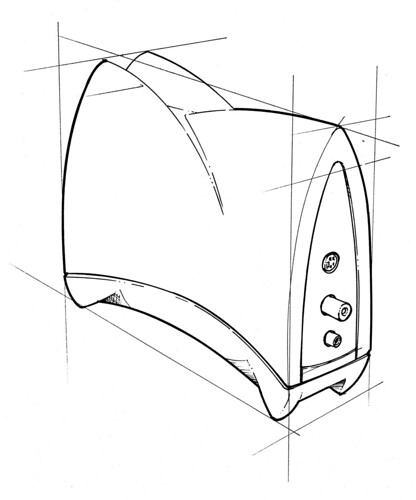
Carefully creating boundary boxes in light lines, as well as over drawing shapes gives a cool sketchy feel.

5) Redraw your sketches and present them in a better 

light.


I have seen many portfolios of designers with a few years of 

experience still include sketches from their school days. Now if 


you have been following my advice your sketching ability would 


have improved, so re-draw those old and ugly sketches, there 


is nothing and no-one saying you should not.


This time, perhaps, take the opportunity to refine it to the level that you are happy with?


6) Use callouts with cool handwriting.

I don’t think I have to say much more about this, but the fact 

that annotations at strategic places does makes a sketch look 


cool. Oh and if your handwriting is not too good, I do suggest 


you pick up a book on drafting and practice.


7) Use the photocopier to save redrawing a good part.

I only recommend this if your sketching ability is fairly good or 

if you are rushed for time. Otherwise redraw it from scratch. 


Photocopiers work great with Liquid Paper or Correction Fluid.


8) Draw big, but show it small.


Actually a great presentation trick is to scan in your images, 

touch up the lines with Photoshop, and present them in a 


collage. Such a presentation strategy makes average sketches 


look good, and good sketches look GREAT!


9) Draw small, but show it big.


If you have still a tough time sketching from your elbow or 

shoulder and if your line control is still not the best, what I 


suggest is to draw a thumbnail and blow it up on a photocopier 


or scanner. This way you would have an underlay to redraw your  
sketch with the same look and feel but with thinner lines.


10) Use layouts created from 2D or 3D software.


Talking about the use of an underlay, use this time tested 

trick to create your sketches with a correct perspective, or for 


you to create a 2D orthographic sketch in proportion.


11) Draw with a pen.


From what I’ve been told, sketching with a pen, instead of a 

pencil, is really about losing the ability to erase your lines, or 


erasing your mistakes.


The idea here is that drawing with a pen forces you to think

before your draw, and as you cannot erase your work, and you


will then draw with a determined solution in mind. In other 


words, drawing with a pen trains your mind to think the design 


solution through before you actually put it on paper. It will 


make you a much better designer.


The other reason is that, you stop being precious with your 

sketches and drawings, i.e. you draw and if it does not look 


good, you don’t get to erase and draw over, but you throw your 


drawings away and start fresh. This re-setting and starting 


from scratch seems to help make you a better designer, so the 


say!


There you go, 11 great tips to get you out of the stable with a 

flying start. However at the end of the day, all these 11 points 


will all come to naught if you don’t practice Practice and 


PRACTICE! So do hang in there as the pain will not last forever.


ELEMENTS OF DRAWING


Line

LINE is straight or curved, heavy or light, soft or hard or a mixture of them all.


LINE can characterise a shape by being the edge of an area or surface, colour, tone or pattern – it becomes an outline or contour.


LINE can show MOVEMENT.


LINE can suggest RHYTHM.


LINE can create TEXTURAL results.


LINE can indicate EMOTIONAL effects.


Shape 


SHAPE can be bordered by a LINE.


SHAPE can be defined by COLOUR, TEXTURE or TONE.


SHAPE can suggest movement or emotions.


SHAPE in 3-D is called FORM.


SHAPE can be sharp and clear or hazy and suggesting something.


SHAPE can be NEGATIVE or POSITIVE.


Colour 


COLOUR is an element of design with endless variety.


COLOUR is a mixture of 3 primary colours, red, yellow and blue.


SECONDARY COLOURS are a mix of 2 primary colours, orange, green and purple.


TERTIARY COLOURS are a mix of the 3 primary colours, red, yellow and blue. Many different colours can be made by changing the amount of primary colours used.
Colour has TEMPERATURE – reds and oranges feel warm like the sun or desert. Cooler colours like blues and greens go more with water and ice.


INTENSITY of colour is its strength and purity.


HUE is the quality that separates one colour from another.


TONE VALUE is the degree of lightness or darkness of a colour, yellow is light, blue is dark.


TINTS are made by adding white to a colour.


SHADES are made by adding black to a colour.

---------------------------------------------------------

ANALOGOUS COLOURS are hues lying near each other on the colour wheel, red-orange, red-purple.


COMPLIMENTARY COLOURS are hues opposite each other on the colour wheel, red and green, purple and yellow.


DISCORD is where opposite colours are together and one is a tint, so that the original tone of the hue is different.


Tone


TONE is light and dark. Light reveals, shows the world to us, and shadow gives meaning to the things we see.


TONE can give solidity, volume and weight to an image


TONE gives the impression of distance. Darker tones come forward and lighter tones go back into the image.


TONE can give emotion to an image. Highly contrasting tones give life and energy, softer tones give a gentle mood.


TONE can create rhythm, with the eyes jumping from one dark tone to another.


TONE is the property of colour. Yellow is light, blue is dark.


TONE in sculpture is the way it catches the light, so that sharp changes are made by deep corners, and gentle ones by smooth gradual changes.

Texture 


TEXTURE is the part of the surface that can be felt or seen.


TEXTURE is concerned with touch, how something feels.


TEXTURE can be rough, smooth, spiky, soft, velvety, regular or irregular.


TEXTURE can suggest emotions by linking with the memory of how things feel.


TEXTURE can be real, the surface is actually rough or smooth or it can be suggested by the way the surface is treated.

Direction 


DIRECTION is about how our eyes move around the artwork.


DIRECTION can be horizontal, vertical, curved, sloped or straight.


DIRECTION can suggest movement by the speed at which it is changed.


DIRECTION can be balanced to give stability or imbalanced to give tension


DIRECTION can have an emotional impact. Using rapid changes in direction or use of diagonals, can cause anxiety while horizontals and verticals bring about calm.

Size 


SIZE is about the bigness or smallness of an area.


SIZE can give space, it can make closer objects appear larger and make distant objects appear smaller.


SIZE can be given by comparing one element that is larger or smaller than the other.


SIZE can make a particular element look important.


Mass


MASS is the amount of material in any sculptural work.


MASS can be suggested in a painting or drawing.


MASS can be heavy or light in effect.


SPACE or VOID refers to the lack of mass.

TYPES OF PERSPECTIVES

Definition: Perspective drawing is a system of representing the way that objects appear to get smaller and closer together, the further away they are.

What Does Perspective Look Like?

Imagine driving along a very straight open road - the road, the fences and power-poles all diminishing towards a single spot far ahead of you. That's single-point perspective. Single- or one-point perspective is a simplest method of making objects look three-dimensional. It is often used for interior views or trompe l'oeil (trick-the-eye) effects. Objects must be placed to that the front sides are parallel to the picture plane, with the side edges receding to a single point.


Is that the same as Linear Perspective?

When we talk about perspective drawing, we usually mean linear perspective. Linear Perspective is a geometric method of representing the apparent diminishing of scale as the distance from object to viewer increases. Each set of horizontal lines has its own vanishing point. For simplicity, artists usually focus on correctly rendering one, two or three vanishing points.

One Point Perspective

In One point perspective, the horizontals and verticals which run across the field of view remain parallel, as their vanishing points are at 'infinity', with horizontals which are perpendicular to the viewer vanish towards a point near the center of the image.

Two Point Perspective

In Two point perspective, the viewer is positioned such that objects (such as boxes or buildings) are viewed from one corner, so that two sets of horizontals diminish towards vanishing points at the outer edges of the picture plane, while only verticals remain perpendicular. It is slightly more complex, as both the front and back edges, and side edges, of an object must be diminished towards vanishing points. Two-point perspective is often used when drawing buildings in the landscape.


Three Point Perspective

In Three point perspective, the viewer is looking up or down so that the verticals also converge on a vanishing point at the top or bottom of the image.


Atmospheric Perspective

Atmospheric perspective is not linear perspective, but rather attempts to use control of focus, shading, contrast and detail to duplicate the visual effect of near objects being crisp and clear, while distant objects may be less distinct and muted.


Tips on how to be a sketch Artist ..

Tips on how to be a sketch Artist ..

1) Know how you draw?
Do you draw lines by moving your wrist, elbow or shoulder? There is really no right or wrong way to draw, though most purist advice to use draw from the shoulder. The reason for this is really about the type of sketch you want to create.
Wrist action encourages “tight” sketches and very good for a controlled sketch style. Drawing from the shoulder gives you a more sketchy and loose lines as you are literally firing off the lines. If you want the create that Emotion sketch this is the technique to use, but frankly this style requires a lot of practice in controlling your lines. Drawing from the elbow gives you the middle ground. At the end of the day pick the technique that you are most comfortable with.

2) Practice.
When I started my design career, I drew everything every day. I refused to use tracing paper, rulers or erasers. If you want to improve your sketching skills you need to invest time and effort. Practice drawing buttons, perspective cubes, and horizontal or vertical lines. I have pages full of horizontal vertical and daigonal lines. 

3) Understand the concept of varying line weights.
One of the good tricks of sketching is to use different line weights or thicknesses. Basically you use thicker lines for edges further from the eye, and thin or dotted lines for edges closer to you.
creature
Varying line thicknesses give your drawing movement, and bold outlines in particular makes the sketch jump out of the page.
4) Use intentionally sketchy lines by keeping your arm loose.
In other words lines don’t end at the junction, keep them going and shoot them off. Creating loose sketchy looking lines is really a technique that can be easily learnt.
brawn
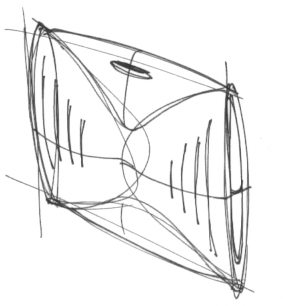
Carefully creating boundary boxes in light lines, as well as over drawing shapes gives a cool sketchy feel.
5) Redraw your sketches and present them in a better light.
I have seen many portfolios of designers with a few years of experience still include sketches from their school days. Now if you have been following my advice your sketching ability would have improved, so re-draw those old and ugly sketches, there is nothing and no-one saying you should not.
This time, perhaps, take the opportunity to refine it to the level that you are happy with?
6) Use callouts with cool handwriting.
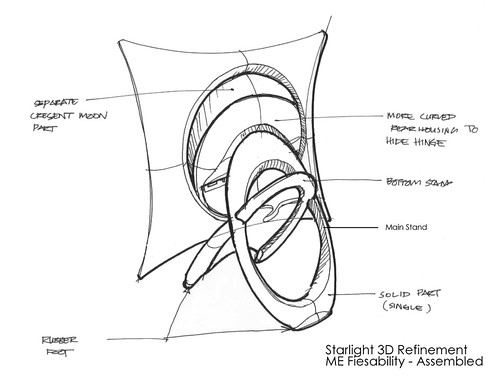
I don’t think I have to say much more about this, but the fact that annotations at strategic places does makes a sketch look cool. Oh and if your handwriting is not too good, I do suggest you pick up a book on drafting and practice.
starlight_me_pin01
7) Use the photocopier to save redrawing a good part.
I only recommend this if your sketching ability is fairly good or if you are rushed for time. Otherwise redraw it from scratch. Photocopiers work great with Liquid Paper or Correction Fluid.

8) Draw big, but show it small.
Actually a great presentation trick is to scan in your images, touch up the lines with Photoshop, and present them in a collage. Such a presentation strategy makes average sketches look good, and good sketches look GREAT!

9) Draw small, but show it big.
If you have still a tough time sketching from your elbow or shoulder and if your line control is still not the best, what I suggest is to draw a thumbnail and blow it up on a photocopier or scanner. This way you would have an underlay to redraw your sketch with the same look and feel but with thinner lines.

10) Use layouts created from 2D or 3D software.
Talking about the use of an underlay, use this time tested trick to create your sketches with a correct perspective, or for you to create a 2D orthographic sketch in proportion.

11) Draw with a pen.
From what I’ve been told, sketching with a pen, instead of a pencil, is really about losing the ability to erase your lines, or erasing your mistakes.
The idea here is that drawing with a pen forces you to think before your draw, and as you cannot erase your work, and you will then draw with a determined solution in mind. In other words, drawing with a pen trains your mind to think the design solution through before you actually put it on paper. It will make you a much better designer.

The other reason is that, you stop being precious with your sketches and drawings, i.e. you draw and if it does not look good, you don’t get to erase and draw over, but you throw your drawings away and start fresh. This re-setting and starting from scratch seems to help make you a better designer, so the say!

There you go, 11 great tips to get you out of the stable with a flying start. However at the end of the day, all these 11 points will all come to naught if you don’t practice Practice and PRACTICE! So do hang in there as the pain will not last forever. Sketching and drawing is like riding a bike, once you get it you will never forget it.
www.architecturedesigncareers.com

www.nata.in
  

COLOUR : EMOTIONS AND PSYCHOLOGY


VIOLET - Royal, rich, stately, passionate, impressive, nobility, spirituality, and ceremony.
BLUE - Serene, calming, cool, quiet, sleepy, sad,cleanliness, order, and loyalty.
GREEN - Fresh, successful, loving, greedy, restful, and calm.
YELLOW - Sunny, bright, hopeful, jealousy, optimistic, joyful, clear, positive, alive,illness, hazard and friendship.
ORANGE - Happy, cheerful, fresh, motivated, warm. vibrant, expansive, flamboyant, and demanding of attention.
PINK - Soft, innocent, delicate, tenderness, acceptance and calm.
RED - Alert, warning, sexual, aggressive, energetic, cheerful, angry, vital, exciting, deadly,fire, blood, and war
BROWN - Warm, earthy, drab, simplicity, and comfort
BLACK - Power, sexuality, sophistication, formality, elegance, wealth, mystery, fear, evil, unhappiness, depth, style, evil, sadness
GRAY - Well-informed, subtle, dignified, gloomy, cold
WHITE - Clean, pure,precision, innocence, youth

How to Draw the Human Figure

The best way to start learning body proportions is to study the classic division of the human body into eight equal parts, from the top of the head to the bottom of the feet. Each of these eight parts is roughly the size of a head.  The four lower parts are the legs. The knee cap is places on the second division. The waist is on the fifth and the top part consists of the head. Remember that these are idealized measures. No two people look exactly the same (with the exception of identical twins) so you have to change the body proportions slightly if you want to depict a specific model. For example most people have a slightly larger head and shorter legs than this classical template. On the other hand if you want a more exaggerated look, like a comic superhero, you might want exaggerate specific parts (especially those related to his/her superpowers).


That's all relatively simple if you’re drawing a person just standing straight up. But in most cases you'll want to add perspective and action to the character; make him bend, jump or crunch for example. Then it gets much more difficult to compare the sizes of the different body parts, an arm extending towards you will seem shorter and so on. To get around this problem you have to think of the human body as a collection of simple shapes. If you think about the arm as a cylinder it will be much easier to figure out how it should look like in 3D.


Buy a wooden drawing mannequin (model , can be bought from stationary shops) and place it on your desk. The mannequin is made up of simple shapes and is a great way to learn how to keep the body part sizes in perspective as it moves in different ways. Keep practicing and you’ll soon notice you get the hang of it.


Once you practiced enough using drawing mannequins , it's time to perfect your abilities. Drawing from real life is an excellent way to perfect your skills in drawing the human figure. Not only will you improve your knowledge of the shape and proportions of the body but you'll also learn where to add shadings and shadows and how to draw all those small details that make a drawing more lively and natural.


When drawing with a model it’s a good idea to vary the times for the different poses. Longer poses, perhaps 10 or 15 minutes each, which will give you time to focus on all details and shading, alternated with quick 30 second poses. 30 seconds might sound extremely quick and absurd, but this will force you concentrate on the main forms. You will learn to quickly see what is important to create a realistic drawing, and what is not.

DRAWING A FOOT

A lot of things must be considered in drawing the feet. First, the feet’s shape must be portrayed with an accord to the size of the character. It can be fat or slight, large or small depending on the size of the other parts. Second, the views and situation affects the outward looks of the feet. Lastly, proportions and shapes must be exact. The curves are emphasized as well as the bending of the fingers.


 Image

Geometric Structure
The first step we’re going to do is to divide the feet into three parts. Each has their own geometric shape depiction. As you can see, the heel is represented by a trapezoid, and a triangle is horizontally divided to represent the upper part of our feet and the lower part which includes the fingers as it is shown in the figure.
And then, by rotating the figure 180 degrees horizontally we can see that the other side of the feet shows another picture different from before. This is the inner part of the feet. Instead of doing the same way as we did before, we draw an arc passing through the intersection point of the three geometric figures to indicate the hollow part under our feet. Image
Fleshing
Those geometric figures would be fine if we are to draw robots. But since we’re not then we will add some flesh on it. Fleshing is adding curves and irregular shapes to our feet for it to look like one. Observation is very useful when drawing something as complex as the feet. Study your own real feet for you to learn how these curves are depicted on your drawing. Image
Final Retouch
The final shape of the feet must be properly outlined. Unnecessary lines or sketches must be erased to see the clear picture of your work. You may add some detail on your drawing to make it more believable, shade portions to indicate tones and shadows. Finally you are done with your master piece.

Feet can be difficult to draw because they are an odd combination of shapes as well as the other body parts. But mastering the methods of drawing body parts is the beginning for one to be a skilled artist. Now that you learn one of these methods and practice mastering it you will soon realize a method of your own. Drawing will be no more problem no matter what views, no matter what action poses. Be creative, just practice drawing, practice more and practice always.

DRAWING CARS

Drawing a car is easy but if it comes on drawing one that looks real then that is another issue. There are three major steps on drawing real looking car. Choose your car model first, one that you like the most and which you think is easy to draw. After deciding what to draw start depicting the image on your clean sheet of paper.
Making it as a Perspective Drawing
A perspective drawing is one way of representing a three-dimensional image on a plane where it appears as realistic as possible. It is a way wherein you are to choose a vanishing point and project all the possible lines or edges of the car from it. In that manner it will appear as if it is projected on some views rather than just facing the viewers. There are two rules to be noticed in this method. First, parallel lines or the edges of your car must meet at your vanishing point. Second, objects become smaller as they appear closer that same point. This is a simple way on building a mental impression on your viewers even if they don’t have any art background.

 Image

Varying the Tone and Contrast
Another way on producing a good quality drawing in black and white is varying its tone and contrast. Just imagine how an image would appear in a two-dimensional plane with only straight lines and curves, would it be beautiful? The answer is no. As an example, people are being attracted on portraits that convey different color intensity, brighter or darker. In reality thing that we see become blur if it’s farther. To apply this on our drawing we are to shade some portions of our car with the use of different types of pencils. After doing this we are now ready to draw our car’s shadow. Image
Adding Shadows
Shadow is a space with the absence of light or light can’t reach because of some obstacle. Every object can create its shadow if light is projected to it. Drawing a shadow is easier than the varying the tone and contrast. Try to think of a point where light is to be projected to your figure. From that point draw lines that extend on the vehicle’s edges and draw the same image of your car with those points and shade it. Image
These three tips will be a big help not only in drawing cars but also in sketching other objects. If you find some difficulties on drawing your own model after some tries then you can have a picture placed in front of you as your guide. It is more preferable for a first timer to have some picture as a reference. In that sense they can think of better images and a way of drawing the next time they would draw a car. Image
Drawing cars and other images involves different kinds of techniques. With your drawing skills and knowledge on these techniques you can almost draw anything. It requires a lot of practice in order to improve, so next time you draw a car place the driver or a passenger in it.

TEXTURE PHOTOGRAPHY

What Is Texture Photography?

Texture photography is one way of drawing the viewer’s attention into the image. Photographs that use this technique create impact by showing different textures. When used correctly, the effect of the texture of the elements in the image can become as commanding as the use of pronounced colors, dramatic scenery or induced movement by lines.

Kinds of Texture Photography
There are three major categories under this type of photography. Detail presents the aspects seen on the surface of the material. Identifying what the object is less significant. A macro lens is usually used to focus on the details. With drama, the texture is not the most important, but one of the components of the image. It is the relationship between the textures which is important. Information is the third type. It is used to help understand what the image is.

Composing Texture Photographs
Contrast, curves and patterns are aspects of texture photographs which can help compose an image. Contrast, whether tonal or color, makes the texture detail show up even more. Curves help convey a sense of movement with leading curves directing the attention towards the focal point. Non-leading curves have no specific direction but still give information about the image. Patterns can help catch the viewer’s attention. Combining multiple patterns can support each other. Another method is by breaking the pattern for an interesting effect.

Shade & Shadow: Basic Shapes


Shadow exampleBasics
Shading can be a bit tricky at first but its not as difficult as it seems. The picture to the right shows a light bulb and several geometrical shapes; circle, triangle, cylinder, and a square.

You'll notice that one side of the shape is light and the other is darkened. All you need to know or keep in mind is just that. What the light doesn't hit, it is darkened. In this example, all you have to do is picture the light source and the object which is being hit by the light --  which part will the light hit? How far will the light go? 
You also have to ask yourself where is the light source coming from? If the light is far above, the shorter the shadow is (try checking out your shadow at noon - 12:00 PM) whereas the lower the light, the longer the shadow will become. According to the light source, make your shadow fit accordingly.

Good thing to remember also: what is the shape of the object I'm giving a shadow?Each of the shapes in the picture each have their own unique cast. The triangle has a pointy shadow, the circle has a circular shadow, the cylinder has a rectangular shadow, and the cube has a "L"-like shadow. At a different angle, though, the cube will cast a different shadow shape. For instance, if the light was head-on to one of the flat sides, it will cast a square to rectangular shadow depending on the light source's height.
With that in mind, you also need to remember: what is the shape of the object the shadow is falling on top of? The current example only has a flat surface on which the shadows fall but in most cases, shadows of - say a character - will fall on rocks or on water, which will look different compared to each other. 
Shadow example 2Tips to keep in mind:
-The darker the shadow, the brighter the light source.
-As the shadow is drawn further from the object, the lighter it becomes.
Drawing the ShadowThe shadow takes on the shape of the item it comes from. If you look to the example picture to the left, you will see various shapes and their shadows being cast. Notice that to make the shadow, all you have to do is create a triangular shape from the top of the object to the ground and back to to the base of the object.
The cube is a bit more complicated as there are two and in some cases, three triangles you have to draw when at an angle.
Drawing the shadow on the ground, I drew in dotted lines to indicate the shape of the shadow - which is basically the same shape as the object itself. Again, you'll notice that the cube does its own unique cast as indicated at the bottom example. It forms an "L" type shadow.
Shading
Shading on an object usually starts midway into the object as shown on the cylinder, cone, triangle, and cube. The circle is also shaded midway but considering that it is round, the shape of the shading also becomes rounded! The result is something quite like an eclipse. Note: Shadows depicted in example image are intentionally drawn entirely dark for tutorial purposes.
Shadow example

Light Source and Shadow The shape of the shadow is also affected by the light source. When the light source is from anything but the sun, like a light bulb, the shadow widens the further it is from the object. The sun, meanwhile, casts a "straight" shadow in that it remains true to the objects shape.

More Than One Light Source A shadow is made for each light source present in a scene. If you are inside a room, for example, and there are two lights on, you will cast a shadow from each light source. This is shown on the right-most example.

Notice both of the bulbs are at the same distance and height from the object. This fact causes the shadows from both light bulbs to be the same. When the light sources are from different distances and heights, the light source that is closer to the object gives off the darker shadow.
Looking at the example again, note that the area where the two shadows meet is darker than the one shadow itself. Dark + Dark = Darker. Keep this in mind when drawing groups of people who's shadows happen to overlap and intersect each other.